
 Facebook
 X
X
 Pinterest
 Copy Link
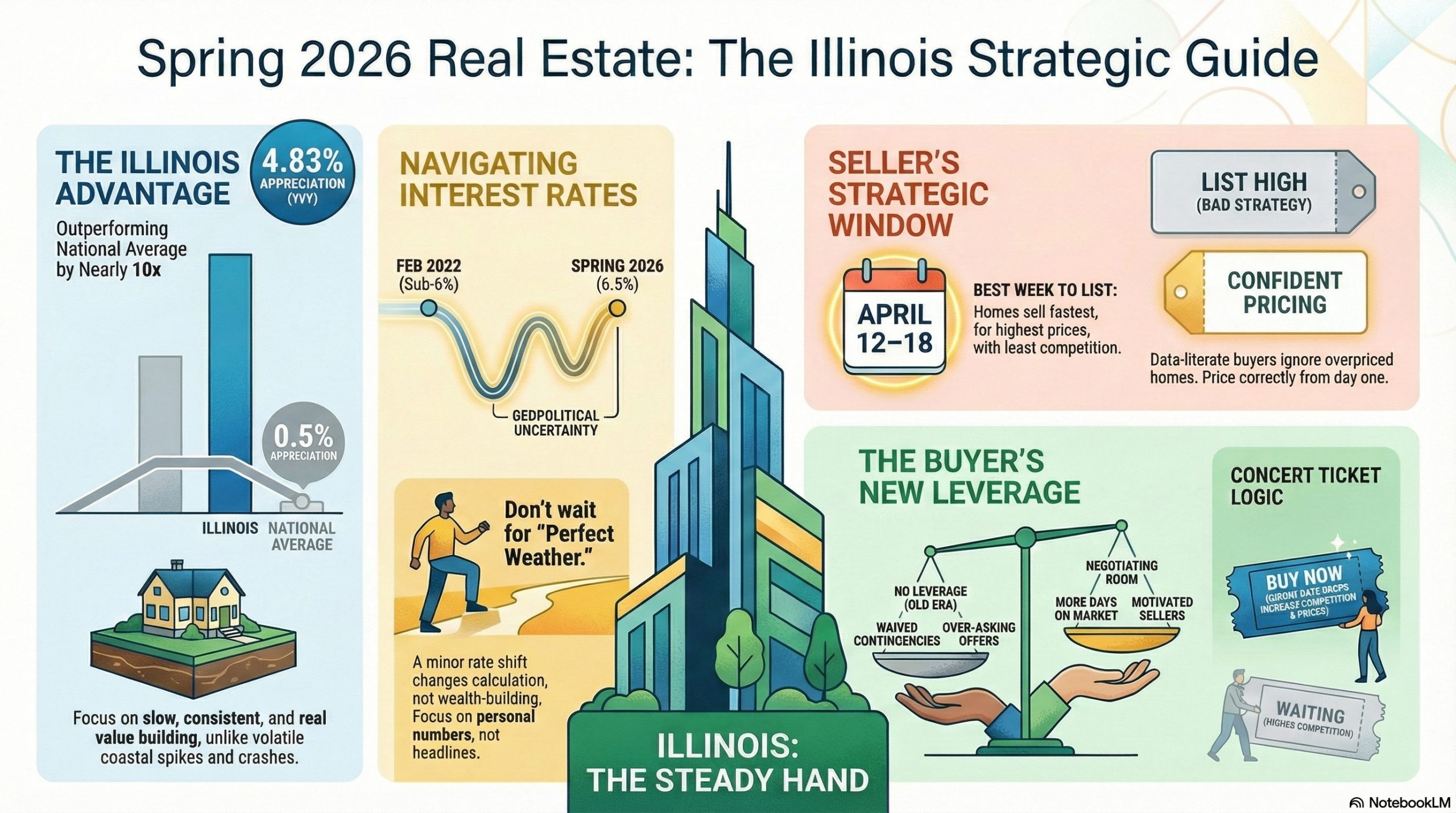
The national housing market is currently caught in a 0.5% appreciation “flatline,” yet Illinois is surging with a 4.83% growth rate. These aren’t just conflicting data points; they are the foundation of a market paradox that is paralyzing the average participant while creating massive opportunities for the strategic investor.
Real estate isn’t actually complicated—it’s just rarely explained with the “straight talk” required to make informed decisions. To navigate this season, you must stop looking at the national noise and start reading the four distinct stories defining the 2026 spring market. Whether you are looking to capture equity or secure an asset, understanding the delta between market perception and mathematical reality is your greatest competitive advantage.
The Illinois Exception: Why the Midwest is Defying the Odds
While much of the country is experiencing a stagnation or correction in asset values, Illinois has emerged as a top-performing state. This 4.83% growth trajectory is a clear signal that the Midwest is functioning as a risk-mitigation strategy in an otherwise volatile national landscape.
This isn’t an accident. The Midwest represents a “steady hand” in a game often dominated by coastal volatility. For those seeking a reliable equity growth trajectory, this regional resilience is a structural advantage.
“The Midwest has always been the steady hand in a volatile game. We don’t spike like coastal markets. We don’t crash like them either. What we do is build—slow, consistent, real value. I’ve always believed that’s a feature, not a limitation.”
If you haven’t assessed your financial position recently, you are likely operating on outdated assumptions. Take a moment to evaluate your current equity compared to just twenty-four months ago. In a market where Illinois is significantly outperforming the national average, your “cost of waiting” to leverage that equity is higher than you realize.
The Interest Rate Fallacy: Psychology vs. Math
In February, we saw a brief window of sub-6% rates before geopolitical shifts pushed them back toward 6.5%. While many buyers hit the brakes, a strategist looks at the actual debt service. A move of 40–50 basis points is a psychological hurdle, not a structural barrier to long-term wealth.
The trap lies in failing to distinguish between monthly payment calculations and a perceived sense of urgency. Waiting for the “perfect” interest rate is the financial equivalent of waiting for perfect weather to start working out; it is a delay tactic that ignores the reality of asset appreciation.
To gain true clarity, I encourage you to run the numbers. Calculate what your actual monthly payment looks like at 6.5% versus a hypothetical 6.0%. Often, the difference is negligible compared to the equity you lose by sitting on the sidelines. Strategic movers understand their numbers and act when the opportunity aligns with their goals, rather than when the headlines feel “safe.”
The “Golden Window” for Sellers (April 12–18)
According to decade-long seasonal data from Realtor.com, the week of April 12–18 is the statistically optimal time to list a home in 2026. This specific window offers a rare convergence of maximum buyer demand, faster closing times, and higher-than-average sale prices.
However, this window narrows rapidly as the season progresses. The advantages of listing now vs. late May include:
Inventory Arbitrage: You are competing against fewer listings now than you will be in six weeks.
Buyer Psychology: You are capturing the “first-movers” before buyer fatigue sets in.
Data-Literate Competition: Modern buyers are rate-sensitive and highly informed. As more inventory enters the market, they become increasingly selective.
A Crucial Warning: The outdated strategy of “listing high to leave room to negotiate” is failing. In 2026, this approach is actively costing sellers time and money. Today’s buyers will not stretch for an overpriced property; they will simply pivot to the next listing. To win in this window, you must price confidently and correctly from day one.
The Buyer’s Secret Leverage: Finding the “Quiet Opportunities”
For the first time in years, the market has shifted away from the “war-zone” conditions of waived contingencies and blind bidding wars. We are entering a period of “Buyer’s Arbitrage”—a window where the hesitation of the masses creates leverage for the few.
Buyers who move now are finding room to negotiate that simply didn’t exist a year ago. With more days on market and increased inventory, you have the space to perform due diligence and secure favorable terms.
Consider the “concert ticket” analogy: everyone wants to buy the ticket before the price goes up, but many hesitate to buy the house until the rates go down. The logic is identical. By the time rates drop, the surge in competition will drive asset prices higher, neutralizing any savings on the interest rate. Early movers may not get the “perfect” rate, but they “get in the building”—and in real estate, getting in is the primary driver of wealth.
“I believe this is one of the quieter opportunities in the current market—and most buyers are sleeping on it because the headlines make everything feel uncertain.”
Final Thought: Strategic Action over Hesitation
The Spring 2026 market demands a departure from “wait-and-see” mentalities. Illinois is outperforming the national average, the most profitable seller window of the year is opening, and buyers finally have the leverage they’ve been seeking.
As you evaluate these four stories, ask yourself: Is your current hesitation strategic, or is it just hesitation? One of those builds a portfolio; the other just costs you time.
Whatever your situation, let’s have a conversation. This isn’t a sales call; it’s a real discussion about where you stand and what makes mathematical sense for your future.
Let’s make it happen.
